On a hot Saturday morning in early May 2016, I walk across Naples, Italy to join a Curiosity Tour at the Metro station at Materdei, our meeting point. Our tour is to include the Cimitero delle Fontanelle, Totò’s house, and the Palazzo dello Spagnolo.
There are about twenty of us in total, the majority appear to be local Italians, including our guide who, like all the Campania guides I’ve met in the city, is young, female and knowledgeable.
Our first stop is the Cimitero delle Fontanelle (the Cemetery/Ossuary of the Springs). I am curious but not keen.
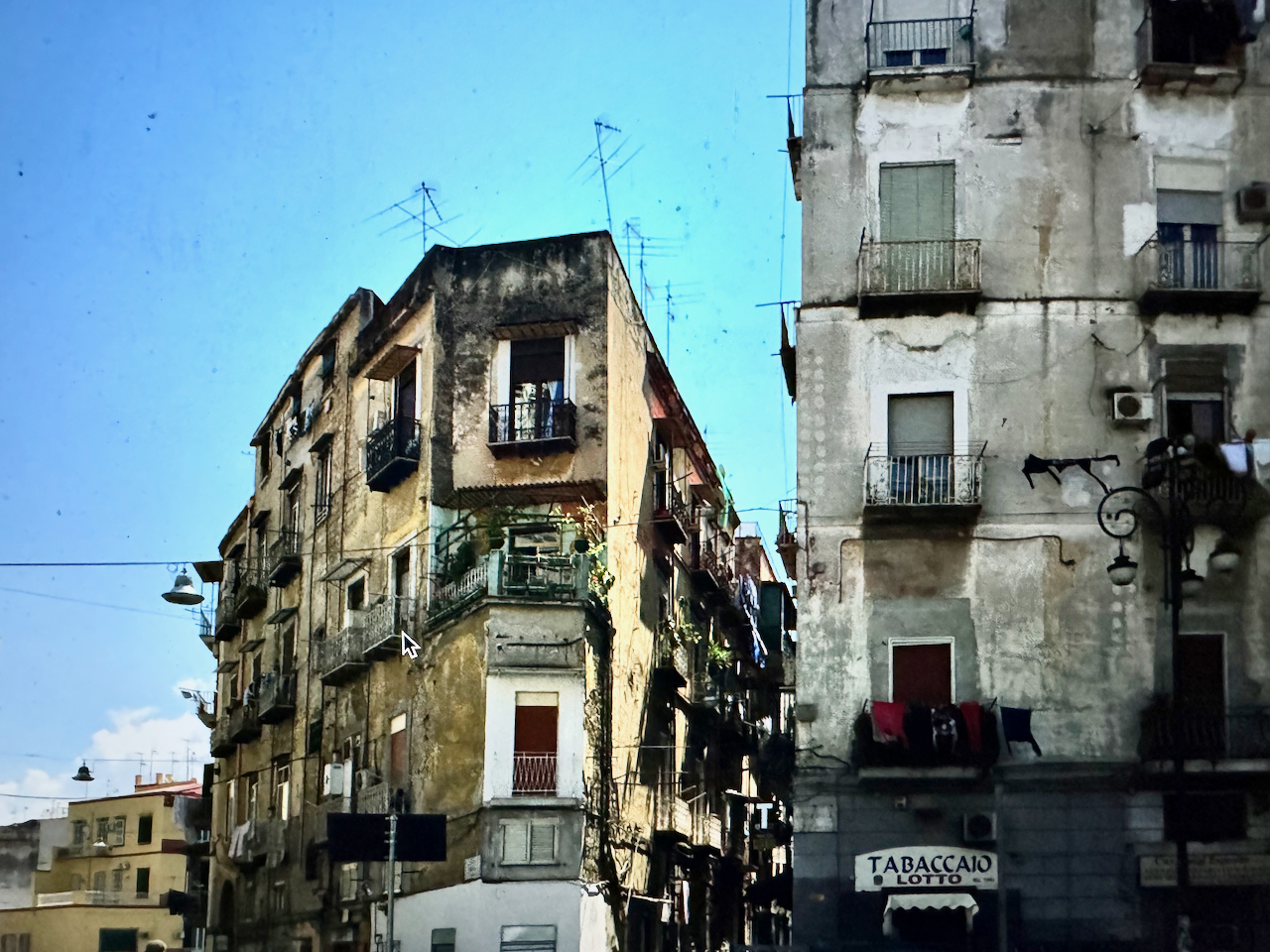
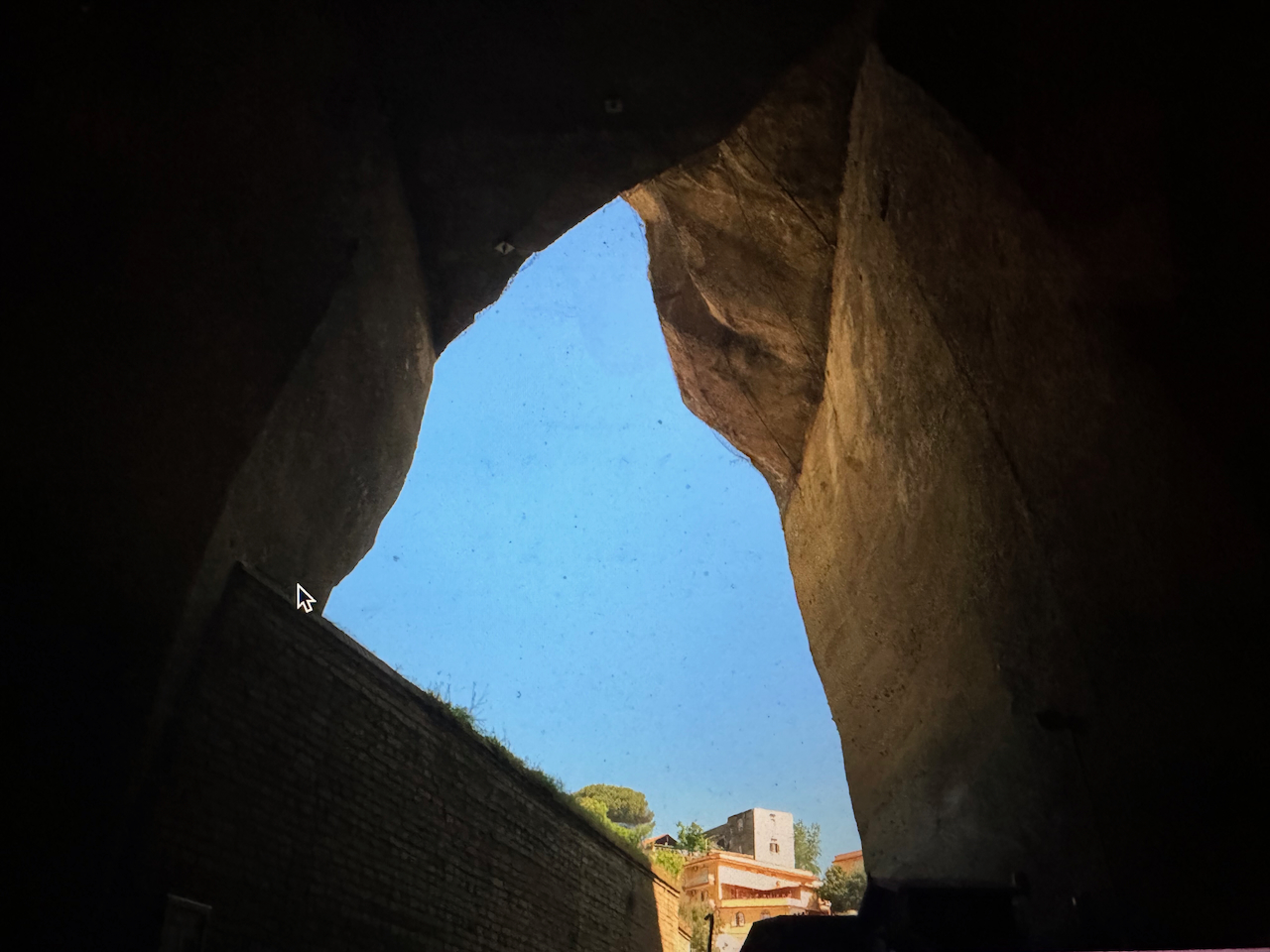
We begin in the everyday suburbia around the Metro, then turn down a steep flight of stairs into an area that looks, in parts, as old and raggedy as a cardboard box washed up by the sea. We squeeze along the narrow pavements behind our guide, my camera too embarrassed to look closer. It’s a relief to turn suddenly in through a modest gate and to stare into the cool, calm welcome of a yawning cave.
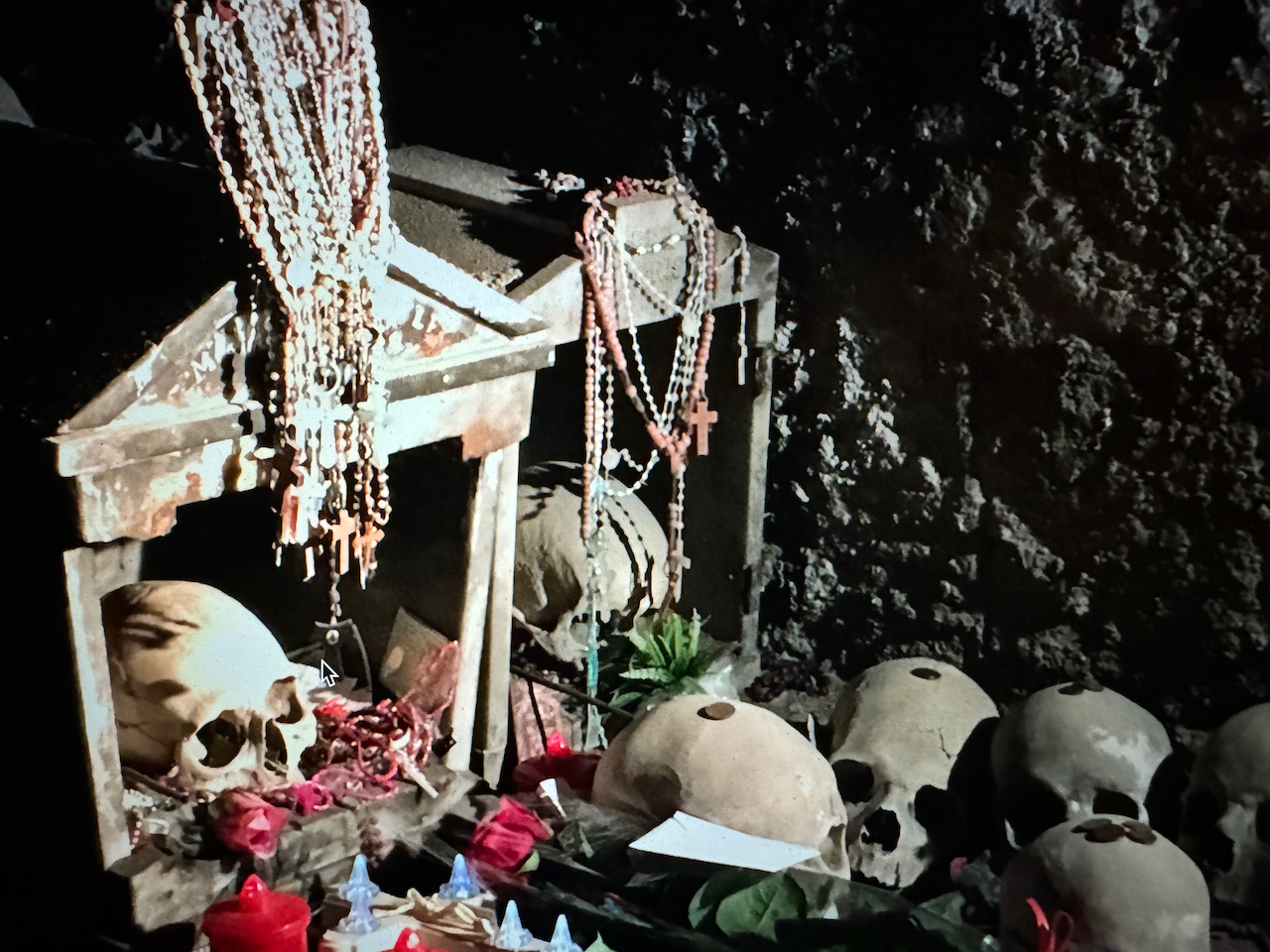
The Cimitero delle Fontanelle is not an ordinary cave. First, it has shallow rows of skulls shining like teeth along the lower edges of its tufa jaws, and second, rather than being dark stone and creepy, its walls are warm yellow and invite the eyes inwards. It is only in the far distance that the shadows become too deep to see what lies beyond.
The cemetery began as a quarry carved out to provide the building stone for Naples but then, in the 1700s when disease and disaster struck the city so fast that the churches could not cope, the empty space was used as a place to leave the dead. At first it was meant only to be used at times of crisis, but by the 1837 cholera epidemic it was recognised officially as a burial site for the poor, and as a final home for the skeletons dug up during building programmes.
It’s a grim history but the big, plain Cimitero delle Fontanelle feels ordered and peaceful, following over a century of devoted respect. Significant attention began with a tidy-up in 1872 under the care of a priest, Gaetano Barbati, and the local community who helped to sort and stack the remains. For some of those involved it was the start of an extreme devotion to the ‘anime pezzentelle‘ (abandoned souls) of Fontanelle.
Members of this ‘cult’ adopted skulls in the hope that care and offerings might earn them some relief from life’s problems, or perhaps help to identify a few lucky lottery numbers. Visits to the cemetery became a weekly fixture on the calendars of the devoted, many of them older women. It was their chance to get out of the house, and into the cool peace and dark of the Cimitero, where they might pour out their problems to the skulls of the departed in the hope that from the hereafter they might be able to influence the here and now.
We wander through the main cave and its side chambers, listening to the stories that give context to the vast space.
Our guide points out the ‘Capitano’ to us, and tells us how young mafia recruits test their courage in the Cimitero. She also tells us that it’s considered auspicious for a grandmother to be accompanied by a grandchild when visiting a skull.
Around us light slants in through openings in the rocks, and the skulls stare, guarding their secrets.
It isn’t a surprise to learn that the Church didn’t like the cult of the skulls and that it closed the Cimitero for most of the last half of the 20th century. Nor is it a surprise to learn that locals weren’t happy with the Church’s decision and that, after protests and restoration work, the Cimitero was reopened. That was in 2012. Now it is tourists who flow through this chamber in the heart of Naples.
We file out into the sunshine to follow our guide back on to the streets of Sanità. We are clearly the strangers in town, easy to spot in our pavement-hugging, single file. We pause briefly in the shadow of Bonaparte’s unapologetic bridge which dominates the area. On the far side of the bridge the church of San Vincenzo ‘O Munacone (St Vincent the Big Monk) stands like a light beneath its dome of bright majolica tiles. On one wall a deep-coloured mural faces on to the piazza while opposite, on a much tireder block of apartments, giant children smile back. Unwittingly both these works of art framed a killing two weeks earlier that left two dead and three injured.
We go into the church for a quick visit. It was built between 1602 and 1610 and is officially titled the Basilica di Santa Maria della Sanità but is known locally as San Vincenzo in memory of the saint whose statue they believe halted the cholera epidemic of 1836.
The church is clean and wide with its share of fine art, but right in the middle of its elegant cloisters is the brutal leg of the road bridge that carries traffic above, apparently indifferent to the neglect trapped in its shadow.
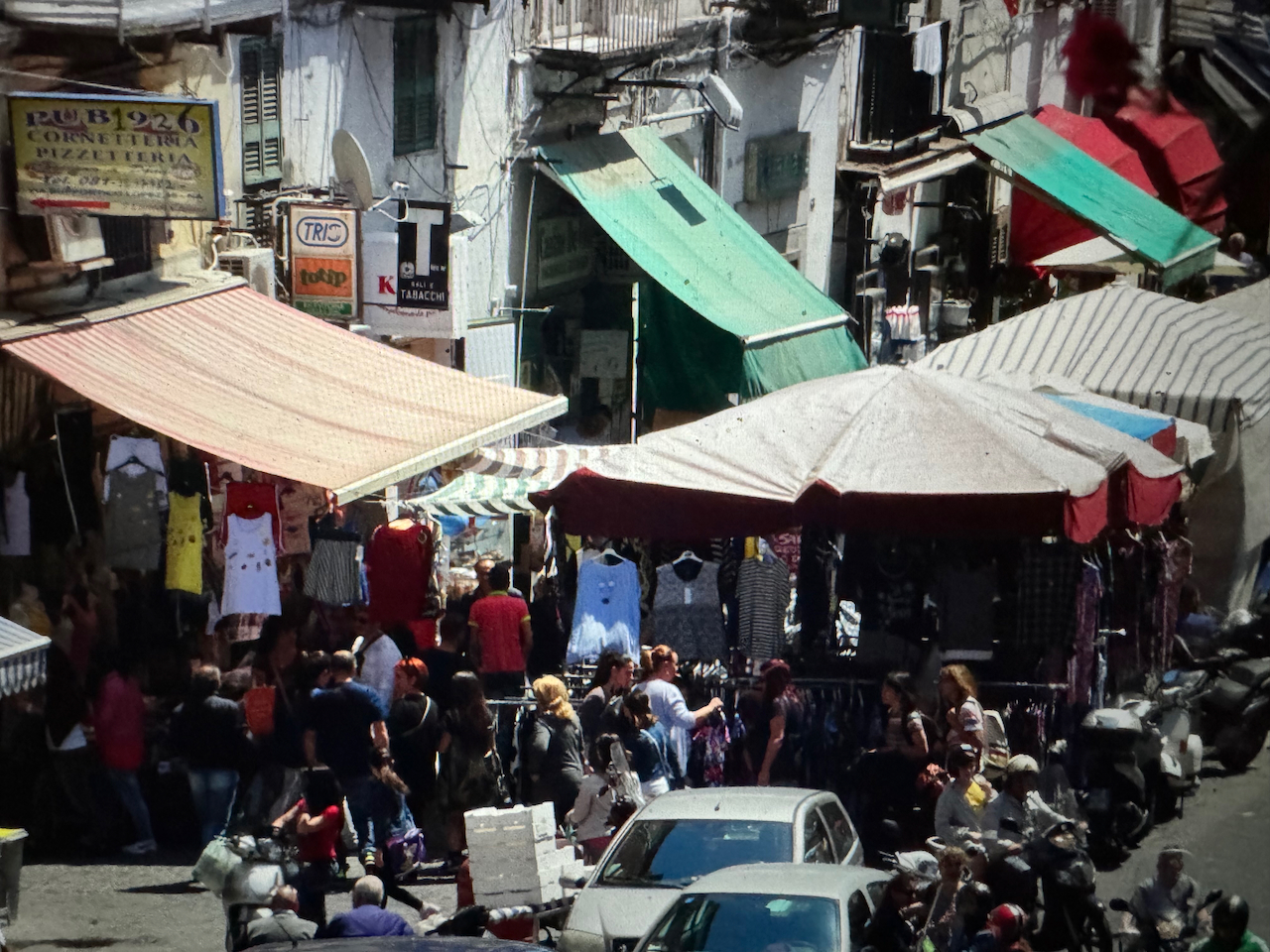
From the church we set off in search of another piece of Sanità’s soul – the birthplace of Totò, in one of the oldest streets in the district, the Via S Maria Antesaecula. The streets feel old – it’s like a walk down the sleeve of a moth-guzzled jumper. The first home of Antonio de Curtis (Totò) – Italy’s genius actor and comic – is just as worn as the rest but the plaque is clean and proud.
Totò’s life, like Sanità’s, was a jigsaw. He was the illegitimate son of the Marqui Giuseppe De Curtis and spent his early years and youth with his mother in the area where he was born, without the support of his father. Theatre fascinated Totò and he was on the stage by the time he was fifteen. His acting career, interrupted by the First World War, moved happily between stage and film, and his charisma and his brand of the seriously absurd carried him from one success to the next. He had a complicated love life and a pedigree that by the end included a full paragraph of titles from two aristocratic fathers: one of them was adopted – the Marquis Francesco Maria Gagliardi Focas – and the other was his own father who did later admit the paternal link. Totò’s life may have been remarkable, but what’s remembered in Naples and across Italy is his lopsided face and the huge range of his work. Sadly, outside the country’s borders, it seems he’s barely known at all.
From the tired building where Totò was born we have one last stop – the Palazzo dello Spagnolo.
It’s exactly as I imagined it, bright and beaming, a smile of a building, while its twin next door gapes in abandoned grey. A family of artists, who live in one of the building’s large apartments in the Palazzo dello Spagnolo, host us to a generous brunch. It’s a breezy, cheerful occasion, full of promise, whilst below us the markets and the locals go about their business – just getting on with getting on.
Life does not look easy in Sanità, a district ridden over by a road and tucked out of sight at the back of the city centre in Naples. Yet the area holds some unique treasures, as well as residents who are determined to build a brighter future one day at a time. The possibility of progress brings pride and hope, but it takes courage to guard the flame.
This article appeared on the first ‘volume’ of The Phraser in the summer of 2016. It has now been moved across to this second volume, with the original photos included where possible. There are a few small changes to the text, and to the arrangement of the piece, to do with style not meaning.